
 Fifty Shades of Mommy
 Originally Published August 11, 2026 by Fifty Shades of Mommy
Growing up, politics was never something we talked about in our house.
I didn’t know who my dad voted for. I didn’t know which party he aligned with, or what issues mattered most to him when he walked into a voting booth. My mom wasn’t able to vote at the time because she didn’t become a U.S. citizen until much later in life, so voting was really something I only saw through my dad.
I even remember going with him to vote when I was a kid. I was there, but I wasn’t part of the conversation. I wasn’t allowed to look at his ballot, and we never talked about who he voted for afterward.
It was private. Completely private.
And for a long time, I guess I assumed that was just how voting and politics were supposed to be. And honestly, I don’t remember learning much about this in school either. We learned about government. We learned the branches, the Constitution, elections, and the basic mechanics of how our system works. But I don’t remember anyone really teaching us how to be a voter.
How do you research a candidate? How do you separate fact from opinion? How do you look beyond a political party and decide which issues actually matter to you? How do you recognize bias, find credible information, or understand what a candidate is really proposing? How do you make a decision when there isn’t one candidate you agree with on everything?
Those are skills I’ve had to learn much later in life.
Ironically, at this stage in my life, I probably know more about politics than I ever expected to know, and quite frankly, more than I ever wanted to know. I pay attention. I read. I research. I look things up when something doesn’t sound right. I try to understand the issues beyond the headlines and social media posts. But I’m also fairly quiet about it. Part of that is because political conversations have become so charged. And part of it is because people sometimes make assumptions about what you know, or don’t know, before you’ve even had the chance to explain where you’re coming from. Sometimes it feels easier for people to assume you don’t know what you’re talking about than to consider that you may have actually taken the time to research it. Maybe that’s another reason I want something different for my kids. Now I’m a parent, and I’m realizing there are some things I want to do differently.
My son is 10, and he is incredibly interested in politics. He asks questions. A lot of questions. He notices things. He wants to know who people are, what they believe, why certain issues matter, and why people disagree. Today, he came with me when I voted in the Wisconsin primary election. This time, instead of keeping him at a distance from the process, I let him watch. He saw my ballot. He saw who I voted for. And naturally, the questions started almost immediately.
And I answered them.
Not because I want him to grow up and vote exactly the way I do.
Actually, the opposite.
I want my kids to understand that voting isn’t about blindly following your parents, your friends, a political party, social media, or whoever happens to be the loudest voice in the room. I want them to learn how to ask questions. To do their own research. To look at more than one source. To understand what candidates actually stand for. To think about how policies may affect them, their community, and someday their own families. I want them to be confident enough to ask questions, informed enough to form their own opinions, and humble enough to keep learning. I don’t want them to believe that being informed means being the loudest person in the room. And I don’t want them to be afraid to say, “I don’t know enough about that yet. Let me look into it.” And most importantly, I want them to know that they are allowed to come to a completely different conclusion than I do.
Someday, my son may walk into a voting booth and vote for someone I would never vote for.
And that’s okay.
Because my job isn’t to teach him who to vote for. My job is to teach him why voting matters, how to make an informed decision, and why his voice deserves to be part of the process. Maybe that’s what breaking the cycle looks like for me. Not rejecting the way I was raised, but recognizing an opportunity to do something differently with my own children. To make politics something we can talk about without turning it into something divisive. To teach them that disagreement doesn’t have to mean disrespect. To teach them that curiosity is a good thing. To teach them how to learn instead of simply telling them what to believe. And to teach them that participating matters.
Today I wear an “I Voted” sticker.
My son wears one that says “Future Voter.”
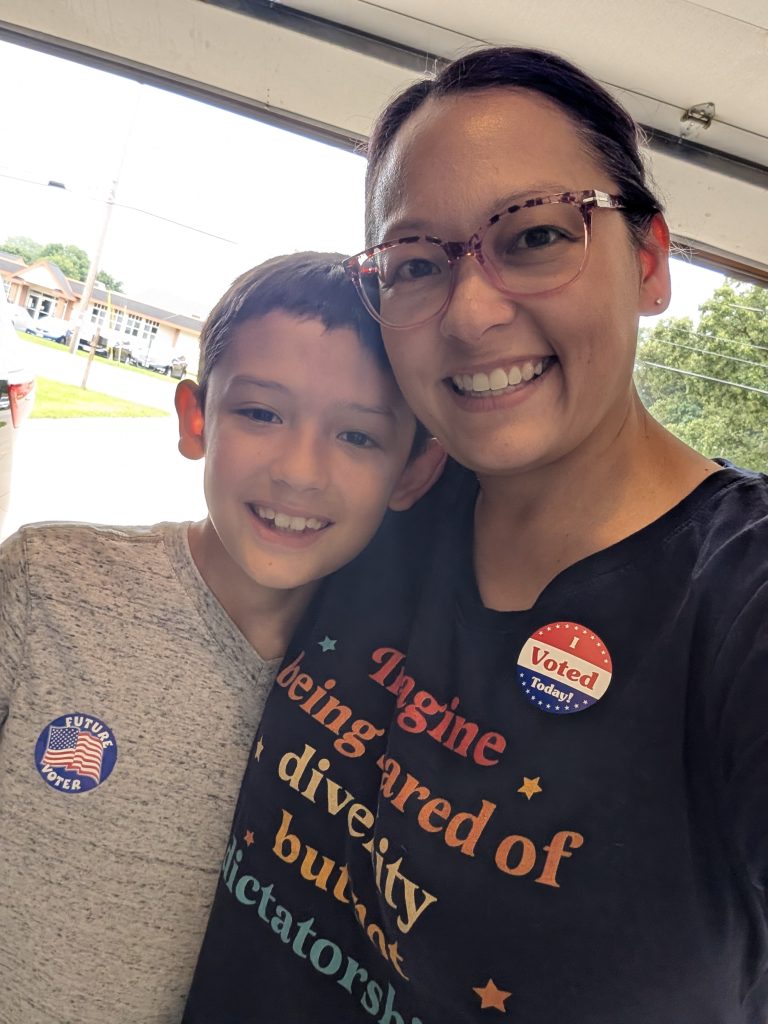
And looking at that picture of the two of us, I realized that might be the whole point.
I’m not trying to create a voter who thinks like me.
I’m trying to raise future voters who know how to think for themselves.